Skip to content
Home » Production Schedule Templates

Production Schedule Templates

Production schedule templates help businesses plan, organize, and manage manufacturing or production activities in a structured way. These templates show what products a company needs to produce, when production should start, how long each process will take, and when the final products should become ready for delivery. Companies use production schedules to manage time, workers, machines, raw materials, and daily tasks more effectively. A production schedule template usually contains important details such as product names, production dates, task assignments, deadlines, quantities, and work progress. Managers use these templates to monitor every stage of production and ensure that workers complete tasks on time. A clear production schedule reduces confusion among employees and helps every department understand its responsibilities.

From procuring raw materials to logistics, production is a challenging task that needs careful attention and effort. Our created these free Production Schedule Templates can easily help you out. As a production supervisor or manager, one can understand the complexity of the process and what it takes to satisfy customers with quality products. Sometimes it becomes difficult to manage the proper resources, raw materials, and logistics when demand is high in the market. As a result, it brings unwanted delays and failure to meet the client’s orders. To avoid all these hitches and ensure smooth production operations in manufacturing units, using a production schedule template is pivotal. It is an astounding solution that can make the whole production process easier and reduce the stress on the managers and staff to pull off the best performances.

How to Create a Production Schedule Template

Creating a production schedule template helps businesses organize manufacturing activities and manage production tasks in a systematic way. A well-designed production schedule allows managers to track orders, monitor progress, control inventory, and meet delivery deadlines without confusion. Many websites provide free production schedule templates that users can download and customize according to business needs. These ready-made templates save time because they already contain structured tables, headings, and planning sections.

Customer details also play an important role in the production schedule template. Companies often include customer names, contact information, order references, and delivery addresses in this section. Accurate customer information helps businesses coordinate production with delivery schedules and maintain strong customer relationships. The total product quantity section shows the number of units required for each product order. Managers use this information to estimate raw material needs, labor requirements, machine usage, and production timelines. Proper quantity planning helps businesses avoid shortages, overproduction, and unnecessary inventory costs. Inventory management forms another key part of production scheduling. The starting inventory section records the number of products or raw materials available before production begins. The ending inventory section shows the remaining stock after production and deliveries. These inventory records help businesses maintain balanced stock levels and reduce waste or shortages.

The start date and end date sections define the production timeline. Managers use these dates to organize workflows and ensure that workers complete tasks within the planned schedule. Clear timelines improve productivity and help companies deliver products on time. Shipping dates also help businesses coordinate transportation and customer deliveries more effectively. Many production schedules also include sections for notes, comments, and delays. Managers can use these areas to record production issues, machine breakdowns, labor shortages, supply delays, or quality concerns. This information helps businesses identify operational problems and improve future production planning. A production schedule template also allows businesses to divide large manufacturing projects into smaller tasks. Managers can assign responsibilities to workers, departments, or production teams based on available resources and deadlines. This organized task distribution improves teamwork and reduces production bottlenecks.

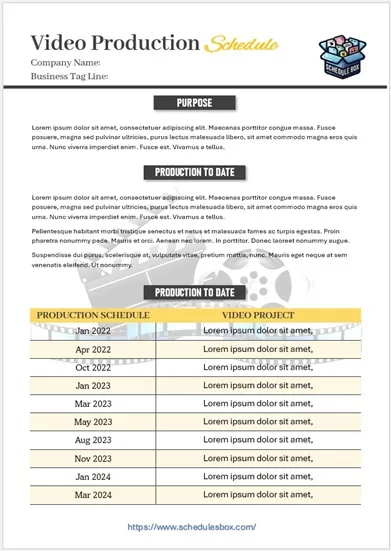
Video Production Schedule Template

Video Production Schedule Template


File Type: MS Word (ZIP File)
File Size: 569 KB

Download Now

Pre Production Schedule Template

Pre Production Schedule Template


File Type: MS Excel (ZIP File)
File Size: 57 KB

Download Now

Master

Master Production Schedule Template


File Type: MS Word (ZIP File)
File Size: 89 KB

Download Now

Key Components of a Production Schedule

Tasks and Activities

This section includes all tasks involved in the production process, such as machining, assembly, quality control, packaging, and shipping. Managers use this list to organize work properly and ensure that every production step receives attention. A detailed task list also helps workers understand their responsibilities clearly and complete work without confusion.

Timeline

The timeline shows the start date and end date for every task in the production process. This schedule helps teams complete activities on time and prevents unnecessary delays. A clear timeline also allows managers to monitor daily progress and ensure that production stays on track according to planned deadlines.

Resource Allocation

Resource allocation explains the labor, machinery, materials, tools, and equipment required for each production task. Proper resource planning helps businesses avoid shortages and reduce unnecessary waste during production. Managers can also balance workloads more effectively and ensure that all departments receive the resources they need.

Milestones and Deadlines

Milestones and deadlines represent important stages in the production process that show the completion of major tasks or project phases. These checkpoints help managers measure progress and maintain control over production activities. Teams can also use milestones to stay motivated and focus on achieving production goals within the planned timeframe.

Dependencies

Dependencies identify tasks that rely on the completion of earlier activities before new work can begin. This information helps managers organize workflows in the correct order and avoid production bottlenecks. Proper dependency planning also improves coordination between departments and reduces delays in the production process.

Capacity Planning

Capacity planning measures the company’s ability to handle production work with available labor, machines, and materials. Managers use this information to create realistic schedules that match production capabilities. Proper capacity planning also prevents overloading workers and equipment, which helps maintain productivity and product quality.

Contingencies

Contingencies include backup plans for handling unexpected problems such as machine breakdowns, supply shortages, labor absences, or delivery delays. These plans help businesses respond quickly when issues arise during production. Good contingency planning also reduces operational risks and helps companies maintain smooth workflow during disruptions.

Monitoring and Control

Monitoring and control involve tracking production progress and making adjustments whenever necessary. Managers use reports, updates, and performance checks to ensure that production activities follow the planned schedule. This process also helps businesses identify problems early and improve overall production efficiency.

Uses of Production Schedules

Manufacturing

Manufacturing companies use production schedules to organize and control the process of making goods. A production schedule helps managers decide what products workers need to produce, how many units they need to complete, and when production should start and finish. This planning allows factories to use machines, labor, and raw materials efficiently. Manufacturers also use schedules to monitor daily production targets and avoid delays in customer orders.

Production scheduling improves coordination between different departments such as purchasing, production, packaging, and shipping. For example, the purchasing department can arrange raw materials before production begins, while the shipping department can prepare deliveries on time. A clear production schedule reduces waste, prevents overproduction, and helps companies meet customer demands more effectively. Manufacturing businesses also use schedules to increase productivity, maintain product quality, and control operational costs.

Construction

Construction companies use production schedules to manage every stage of a construction project in an organized way. These schedules help project managers plan activities such as site preparation, foundation work, structural construction, electrical installation, plumbing, painting, and final finishing. A construction schedule shows when each task should begin and end, which helps workers complete projects within deadlines. Construction projects involve many teams, contractors, suppliers, and machines. A production schedule improves communication among all parties and ensures smooth coordination throughout the project. Managers can monitor work progress daily and quickly solve problems such as material shortages, labor delays, or equipment issues. Proper scheduling also helps construction companies control project costs, improve safety, and deliver completed projects to clients on time.

Film and TV Production

Film and television production teams use production schedules to organize shooting activities and manage the entire filming process. A production schedule helps directors, producers, actors, camera crews, and technical staff follow a clear timeline for every scene. The schedule usually includes shooting dates, locations, scene numbers, actor availability, equipment requirements, and daily production tasks.
Film production involves many moving parts, and poor planning can create delays and increase production costs. A detailed schedule helps production teams manage time effectively and avoid confusion during filming. The team can arrange costumes, lighting, cameras, and props before shooting begins. The schedule also helps actors and crew members prepare for their responsibilities in advance. Organized scheduling allows film and television projects to complete filming smoothly and within budget.

Event Planning

Event planners use production schedules to organize and manage all activities related to events such as conferences, weddings, concerts, exhibitions, and corporate meetings. A production schedule helps planners arrange tasks such as venue booking, decoration setup, catering, entertainment, guest management, and equipment installation. The schedule shows the exact timing for every activity and ensures that the event runs smoothly from start to finish.
Event planning requires coordination between vendors, staff members, performers, and clients. A production schedule improves communication and helps everyone understand their duties clearly. Event managers can monitor preparation progress, handle last-minute changes, and solve unexpected problems more efficiently. Proper scheduling also helps event planners manage budgets, reduce stress, and deliver successful events that meet client expectations.

Software Development

Software development companies use production schedules to manage different stages of software projects in a structured way. A software production schedule helps teams plan activities such as research, coding, testing, debugging, deployment, and maintenance. Project managers use schedules to assign tasks to developers, designers, testers, and technical teams according to deadlines and project goals.Software projects often involve multiple phases and complex technical work. A production schedule helps development teams stay organized and complete tasks on time. Managers can track project progress, monitor workloads, and identify delays quickly.

Film Production Schedule Template

Film Production Schedule Template


File Type: MS Word (ZIP File)
File Size: 91 KB

Download Now

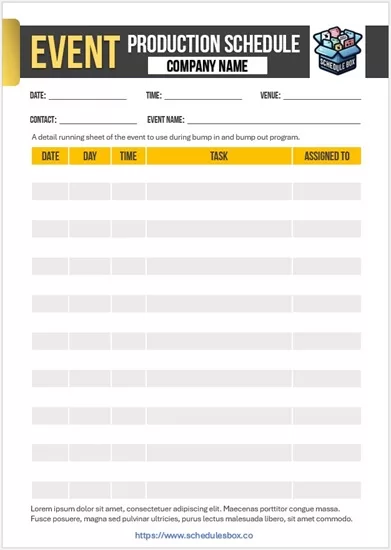
Event

Event Production Schedule Template


File Type: MS Word (ZIP File)
File Size: 91 KB

Download Now

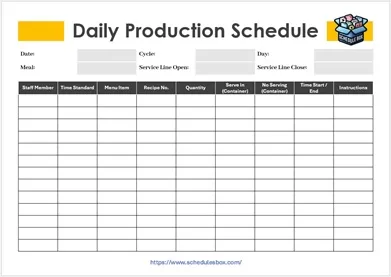
Daily Production Schedule Template

Daily Production Schedule Template


File Type: MS Word (ZIP File)
File Size: 79 KB

Download Now


Benefits of Production Schedule Templates

Production schedules offer so many benefits to the manufacturer, and here are some of the benefits that will make your production process a breeze:

Enhanced Efficiency

One of the pertinent benefits of this template is the improved efficiency of the whole process. Using this template enables you to plan and properly allocate labor, materials, and other resources to the task. Furthermore, it also helps you create a timeline as to how this resource will be executed to accomplish various production tasks. In this way, these schedules exquisitely uplift efficiency and overall operational productivity.

Improved Coordination

Another unique aspect of the production schedule template is that it leaves no ambiguity behind. Once the whole production schedule is in place, it can easily be communicated with staff and departments. Consequently, you will get better coordination among departments. Moreover, with this tool, you streamline communication channels within the production department and avoid chances of confusion by sharing this production process schedule with concerned stakeholders for better communication and coordination.

Resource Management

No matter what scale of manufacturing you are dealing with, if there is no proper resource management system, you will face serious consequences in terms of delays, resource shortages, and elevated production costs. To counter these problems, professional production managers utilize the production schedule templates, as they keep everything clear and give you an overview of how the resources will be acquired and utilized. Therefore, it not only helps in improving production efficiency but also eliminates the chances of increasing production costs extensively.

Boost Tracking

Check and balance are pivotal for obtaining desirable outcomes. With production schedule templates, you become able to efficiently track how the work breakdown structure will be executed by the available resources. You will have all the details as to who is responsible for the specific tasks and what the deadlines are. That is how this production tracking sheet will showcase if there is any production shift going with under or over resources. Therefore, you can make prompt decisions according to completing the production before deadlines.

Decreased Delays

One of the things that hurts the production process is unwanted downtime and delays. When machines or equipment break down or systems start lagging or updating, the whole production process faces downtime. Apart from that, there are many other factors, such as shortages of labor and skills, quality issues, or production process inefficiencies. So, all these things can be overcome using production schedule templates and letting the manager plan beforehand to execute all the resources carefully to prevent such delays and downtime. That is how you can get numerous benefits by utilizing this production process schedule and producing quality products on time with great customer satisfaction.

Production schedule templates help businesses organize tasks, manage resources, and complete projects on time. These templates improve planning, increase productivity, and reduce delays in different industries such as manufacturing, construction, event management, film production, and software development. A clear production schedule also helps teams communicate better, track progress easily, and maintain smooth operations. Businesses that use proper production scheduling can improve efficiency, control costs, and achieve their production goals more successfully.

Leave a Reply

Your email address will not be published. Required fields are marked *