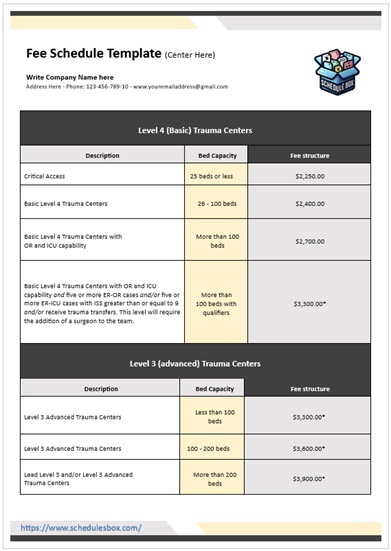
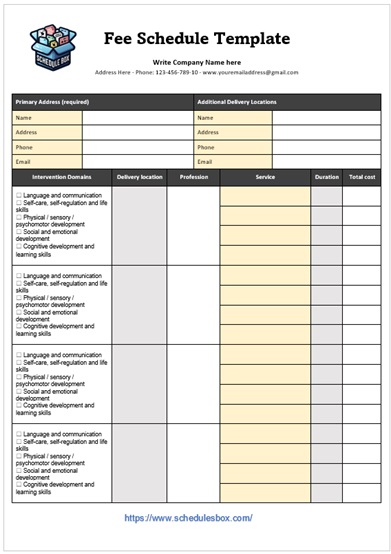
A fee schedule template works as a structured document that organizes and manages payment details for schools, colleges, universities, coaching centers, businesses, hospitals, and other organizations. It clearly presents different types of fees, payment deadlines, installment plans, discounts, fines, and other financial charges. Fee schedule templates help institutions maintain transparency and make sure that students, parents, clients, or customers clearly understand how much they need to pay and when they need to pay it. Organizations can prepare these templates on a monthly, quarterly, semester, or yearly basis depending on their requirements.
Organizations use fee schedule templates widely because they save time and reduce confusion in financial communication. Instead of creating fee details from scratch every time, organizations use a ready-made template and update it whenever needed. This practice improves consistency and increases accuracy in billing and pricing. A school uses a fee schedule template to show tuition fees, transport charges, examination fees, and hostel expenses. A medical clinic uses it to list consultation charges, treatment fees, and laboratory costs. Businesses use fee schedules to maintain clear communication between service providers and customers, which builds trust and improves professionalism.
Importance of Fee Schedule Templates
Fee schedule templates are important because they provide clarity and transparency in financial matters. This helps organizations maintain a good relationship with customers, students, patients, or clients because there is less chance of disputes regarding payments. A properly designed fee schedule also makes financial planning easier for both the organization and the person making the payment.
Another major importance of fee schedule templates is that they improve efficiency and save valuable time. Organizations do not need to create fee details from the beginning every time because the template already contains the required structure. Staff members can quickly update prices, add new services, or make changes without preparing a completely new document. This reduces administrative workload and minimizes errors in calculations or billing information.
Fee schedule templates also support professionalism and record management. A well-organized fee document gives a professional impression and shows that the organization follows a systematic process. It helps in maintaining accurate financial records, tracking payments, and ensuring consistency in pricing. In addition, these templates can be customized according to different industries and purposes, making them flexible and useful for schools, healthcare centers, businesses, consultants, training institutes, and many other organizations. Overall, fee schedule templates play an essential role in simplifying financial communication, improving organization, and ensuring transparency in payment systems.


Uses of Fee Schedule Templates
These free Fee Schedule Templates can help you to plan your Fee Schedule for any kind of situation effectively and quickly. A Fee Schedule is a complete list or document that describes the costs for the services of a firm, a professional, or a medical institution. For each type of service provided or product sold, the specific costs are indicated. In different contexts, a Fee Schedule can serve various purposes:
Healthcare
In the healthcare sector, fee schedules are used by hospitals, clinics, and doctors to clearly list the charges for every medical service or procedure they provide. This includes consultation fees, diagnostic tests, surgeries, emergency care, and other treatments. Having a proper fee schedule helps patients understand the cost of medical services before receiving treatment, which reduces confusion and financial stress. It also plays an important role in communication between healthcare providers and insurance companies. Insurance firms use these fee schedules to determine how much they will reimburse for each medical service, ensuring that payments are fair and standardized. This system helps maintain transparency, avoids overcharging, and makes the billing process more organized in the healthcare industry.
Legal and Consultancy Services
In legal and consultancy fields, professionals such as lawyers, legal advisors, business consultants, and financial experts use fee schedules to clearly define their service charges. These schedules may include consultation fees, hourly rates, case preparation charges, project-based fees, or charges for specialized advisory services. By providing a clear fee structure, professionals help clients understand the cost of services before hiring them, which builds trust and avoids misunderstandings. It also ensures that clients are aware of how they will be charged throughout the service period. A well-defined fee schedule in this sector promotes transparency, professionalism, and fairness in client relationships while making billing more systematic and organized.
Financial Services (Banks and Financial Institutions)
Banks and financial institutions use fee schedules to list all charges related to their services, such as account maintenance fees, transaction charges, loan processing fees, ATM withdrawal fees, and other financial services. These schedules help customers clearly understand the cost of using different banking facilities. It ensures that there are no hidden charges and that all fees are communicated in advance. Fee schedules in financial services also help standardize pricing across different branches and services, making the system more efficient and reliable. For the institution, it simplifies billing, improves record-keeping, and helps maintain transparency with customers, which is essential for building long-term trust.
Service Industries (General Businesses)
Service-based industries like repair shops, cleaning companies, educational institutes, beauty salons, and maintenance businesses use fee schedules to clearly show the cost of each service they offer. For example, a repair shop lists different charges for fixing appliances, electronics, or vehicles, while an educational institute shows fees for courses, training programs, or workshops. This clear structure helps customers compare different services easily and choose the one that fits their needs and budget. A well-organized fee schedule also removes confusion about prices and stops misunderstandings between service providers and customers. As a result, businesses communicate better with their clients, build stronger trust, and run their daily operations more smoothly and professionally.
Overall Purpose of Fee Schedules
Fee schedules mainly aim to bring clarity, standardization, and transparency to pricing across all industries. They clearly show the cost of services so customers understand what they pay for without confusion. This clear structure reduces misunderstandings and lowers the chances of billing disputes between service providers and customers. Fee schedules also make the payment process easier because they follow a consistent pricing system. Businesses use them to plan their income, track payments, and manage financial records in an organized way. Overall, fee schedules help every industry create fair pricing systems, improve communication, and make financial processes simple and transparent for everyone involved.


Customizable Fee Schedule Template
A customizable fee schedule template lets organizations change and adjust their pricing whenever they need. Businesses use this type when they want to add new services, update prices, or offer discounts based on customer needs or market conditions. Unlike fixed templates, this format gives full flexibility and allows quick changes without creating a new document. Freelancers, digital service providers, and modern businesses often use this type because their pricing changes frequently. This flexibility helps them stay competitive in the market and respond quickly to customer demands while still keeping their pricing structure organized and easy to understand.
Contract-Based Fee Schedule Template
A contract-based fee schedule template sets pricing within a formal agreement between two parties before the work starts. Both the service provider and the client agree on all charges, payment terms, and service conditions in advance. This type of template clearly explains what services the provider will deliver and how much the client will pay for them. Construction companies, corporate service providers, and government projects often use this format because they deal with large and long-term contracts. This clear agreement protects both sides from confusion or disputes and ensures that everyone follows the same rules throughout the project.
Types of Fee Schedules
Standard Fee Schedule Template
A standard fee schedule template shows a clear list of services or products with fixed prices in a simple table format. It includes details like service name, description, unit price, and total cost so everything stays organized and easy to understand. Schools, small businesses, and service providers use this template because it helps them present pricing in a clean and consistent way. It also saves time because staff do not need to explain prices again and again. Customers can quickly check all charges in one place, which reduces confusion and builds trust between the business and the customer.
Tiered Fee Schedule Template
A tiered fee schedule template shows different price levels for the same service based on packages or categories such as basic, standard, and premium. Each level includes different features, so the price changes depending on what the customer selects. Businesses like subscription services, consultancy firms, and healthcare providers use this template to offer flexible choices to their clients. It helps customers pick a plan that matches their needs and budget. This type of template also increases sales because it encourages customers to choose higher-value packages when they want more benefits.
Hourly Rate Fee Schedule Template
An hourly rate fee schedule template charges clients based on the time spent on a service instead of a fixed price. Professionals like lawyers, consultants, freelancers, and technical experts often use this format. It usually includes hourly rates, estimated working hours, and the total expected cost. This helps clients understand how their bill is calculated and what they are paying for. It also gives professionals flexibility because they can charge fairly for the exact time and effort they put into a task. This type of template builds transparency and trust in professional services.


Service-Based Fee Schedule Template
A service-based fee schedule template lists each service separately with its own price. It works well in industries where businesses offer many different services, such as hospitals, beauty salons, repair shops, and educational institutes. For example, a hospital may list consultation fees, test charges, and treatment costs individually. This helps customers choose only the services they need and clearly understand the total cost. It reduces misunderstandings and makes billing more accurate. It also improves communication between service providers and customers by keeping everything simple and transparent.
Flat Fee Schedule Template
A flat fee schedule template charges one fixed amount for a complete service or project, no matter how much time or effort it takes. Legal professionals, consultants, and project-based service providers often use this type. It allows clients to know the total cost before the work starts, which makes budgeting easier and stress-free. This template also saves time because it removes the need for detailed hourly tracking or complex calculations. It works best for services with a clear scope and predictable work, where both the client and provider agree on a fixed price in advance.
Fee schedule templates play a key role in organizing financial information in a clear, simple, and structured way. They help schools, businesses, hospitals, and other organizations present all payment details in one place so that everyone understands the costs without confusion. These templates reduce mistakes, save time, and improve the overall efficiency of financial management. They also strengthen transparency between organizations and customers by clearly showing fees, deadlines, and payment terms. When people understand what they are paying for, they trust the system more and avoid misunderstandings or disputes. This makes communication smoother and more professional in every sector.
These fee schedule templates support better planning and decision-making. Organizations can easily update prices, add new services, and manage records in an organized way. Customers can also plan their payments in advance, which reduces financial stress. Overall, fee schedule templates act as an essential tool for fair pricing, clear communication, and effective financial control. They help create a more organized and trustworthy system where both service providers and customers benefit equally.
They also improve discipline in financial processes by ensuring timely payments and proper record keeping. Organizations can track income more effectively and maintain accuracy in accounts. Overall, fee schedule templates create a professional system that supports smooth operations, better financial planning, and long-term stability for both service providers and customers.