DuPont Schedule Templates help companies organize work shifts, tasks, and safety activities in a clear and simple way. Many factories, plants, and industrial businesses use these templates to manage employee schedules and daily operations. A DuPont schedule usually follows a rotating shift pattern that gives workers enough time for work, rest, and personal life. Managers use the template to assign duties, track shifts, and reduce confusion among team members. Workers can quickly check their schedules and prepare for their tasks without stress.
The importance of DuPont Schedule Templates comes from their ability to improve productivity and teamwork. A clear schedule helps employees arrive on time and complete work in an organized manner. Companies can avoid overlapping shifts and reduce mistakes in planning. The template also supports workplace safety because workers receive proper rest between shifts. Tired employees often make errors, so balanced schedules help prevent accidents. Businesses save time because managers do not need to create schedules from the beginning every week. Employees also feel more satisfied when they understand their working hours in advance. These templates create better communication, smoother operations, and a more professional work environment for both workers and management.
Dupont Schedule’s Working
The DuPont Schedule is a type of 12-hour rotating shift pattern used by businesses that require 24/7 coverage. This schedule, developed by the DuPont company, is structured to provide coverage all day and night by using four teams who rotate shifts, covering both day and night shifts over a set period, typically 28 days. Here’s how it generally works:
Shift Length
In a DuPont Schedule Templates system, each shift lasts for 12 hours. Employees usually work either during the day or throughout the night. Companies choose this long shift structure because it reduces the number of shift changes in one day and helps operations continue smoothly. Workers often complete more tasks during a single shift because they spend less time preparing for handovers and meetings. Managers also find it easier to organize teams when employees stay at work for longer periods. Many industries such as manufacturing plants, hospitals, emergency services, and chemical factories use this schedule because they require constant attention and continuous production.
A 12-hour shift can create both advantages and challenges for workers. Employees receive more full days off during the month, which gives them extra time for family activities, travel, rest, or personal work. Some workers enjoy the longer breaks because they can recover properly before returning to work. However, long shifts also demand strong physical and mental energy. Workers may feel tired near the end of the shift, especially during busy or stressful work periods. Companies often encourage employees to take short breaks, eat healthy meals, and maintain good sleep habits so they can stay active and focused during their working hours.
Rotation
The rotation system forms one of the most important parts of the DuPont schedule. Employees usually work three or four consecutive shifts before they receive several days off. This rotation creates a balance between work and personal life. Workers can plan their routines more easily because the schedule follows a predictable pattern. Managers also benefit from the system because they can organize labor requirements in advance and reduce scheduling confusion.
The rotation schedule allows employees to experience both work periods and recovery periods in a balanced way. After several long shifts, workers receive enough time to rest their bodies and minds. Many employees appreciate this arrangement because they can spend quality time with family members, complete personal responsibilities, or simply relax during their off days. At the same time, companies maintain a stable workforce because different teams rotate through shifts without stopping operations. The rotation system also helps reduce boredom because workers experience different schedules and responsibilities throughout the month.

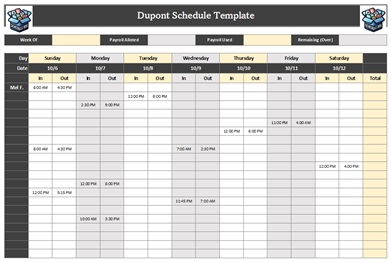
01 Dupont Schedule Template – Daily In and Out
File Size: 46 KB

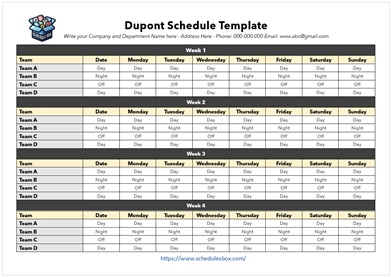
02 Dupont Schedule Template – Monthly Team Plan
File Size: 73 KB

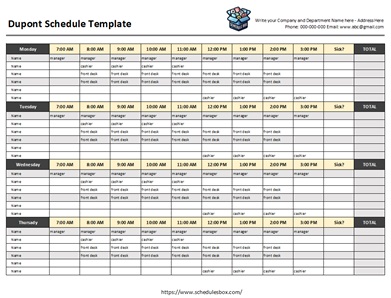
03 Dupont Schedule Template – Hourly Plan
File Size: 45 KB
Pattern
The DuPont schedule follows a rotating pattern where employees switch between day shifts and night shifts within the same work cycle. This system helps companies distribute workloads fairly among workers. Every employee eventually experiences both daytime and nighttime responsibilities, so no single group carries the burden of permanent night duty. Managers use this rotating approach to maintain equality and teamwork among employees.
Despite its benefits, this pattern can challenge workers because the human body naturally follows a sleep cycle that prefers daytime activity and nighttime rest. Employees may struggle to adjust when they move from night work to day work within a short period. Some workers experience tiredness, stress, or difficulty sleeping during transition periods. To handle these challenges, many employees create healthy routines such as maintaining regular sleep schedules, avoiding heavy meals before bedtime, and limiting distractions during rest hours. Companies may also provide wellness programs or rest areas to help workers stay healthy and productive throughout the rotation cycle.
Coverage
The DuPont scheduling system provides continuous coverage for workplaces that operate 24 hours a day, seven days a week. Industries such as power plants, manufacturing facilities, transportation services, and healthcare centers rely on uninterrupted operations to meet customer demands and maintain safety standards. The schedule ensures that one team always remains available to continue the work while another team rests or prepares for the next shift.
This system helps companies avoid downtime and maintain smooth production processes. Managers can quickly identify which team handles each shift, which improves communication and accountability. Workers also understand their responsibilities clearly because the schedule follows a fixed structure. Continuous coverage supports customer satisfaction because services and operations continue without delays or interruptions. In addition, the system helps businesses respond quickly to emergencies or unexpected situations since trained employees remain available at all hours. The DuPont schedule therefore strengthens productivity, reliability, and operational efficiency across many industries.
Complex operations can be staffed easily by use of DuPont Schedule but also calls for proper management as workers should have enough time to rest due to long shifts with fast day and night rotation
Types of Dupont Schedules
The implementation of the DuPont Schedule varies to some extent depending on the specific needs of the organization, but there are some standard kinds that are commonly adopted by most businesses. These are different versions meant to help distribute the workload evenly and allow for some rest time that is vital for continuous functioning. Here are three typical types of DuPont Schedules:
Classic DuPont:
Duration: 4-week cycle
Shift Pattern: Workers usually have a pattern of following, first working four-night shifts, then taking three days off or three-day shifts, and finally one day off, after which they return to work by putting in three-night shifts followed by another three days off before embarking on four-day shifts culminated by seven consecutive days off.
Features: The long break (seven days of rest) before the next morning or overnight work shifts makes this itinerary notable mainly because it allows significant time for relaxation and recuperation.
Modified DuPont:
Duration: Varies, often a 4-week cycle
Shift Pattern: In comparison with the standard DuPont’s schedule, there are likely to be some changes in the sequence and timing of off days and shifts. This may lead to a reduction in the number of days having night shifts one after the other, or could involve modification of the duration of pause that suits particular working requirements better or that workers prefer most.
Features: The modified version wants to solve some problems from the old DuPont schedule like fewer hours between day and night shifts and its total duration.
DuPont with Extended Breaks:
Duration: 4-week cycle or longer
Shift Pattern: It is more like the old DuPont, only that it has extra days off between working days such as two stretches of four days or some long break at the middle of the cycles.
Features: Tiredness and happiness can be reduced by having more rest time provided for in these timetables, it also helps in making the worker feel better as suggested by their design.
All DuPont Schedules have their pros and cons. In choosing a specific schedule, few things are more important than health, safety, compliance with regulatory norms, efficiency in operations, and others. These are the reasons behind many managers’ use of individualized project timelines that curb job frustrations that workers encounter in their daily activities while at the same time ensuring that different organizations attain their wildest dreams of productivity.

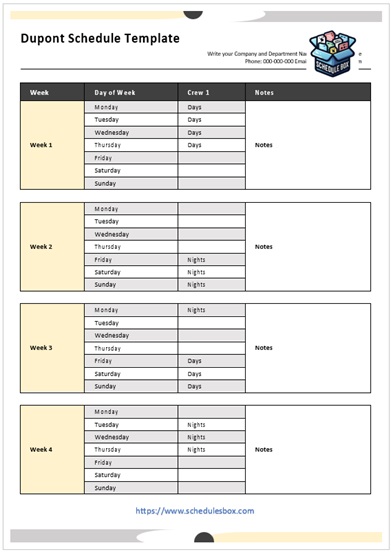
Dupont Schedule Template – Human Resources
File Size: 97 KB

Dupont Schedule Template – Monthly Plan
File Size: 102 KB

When it comes to organizing challenging shift systems, choosing one of the already prepared DuPont Schedule templates is always beneficial for any firm in charge of their management. Here are some of the main advantages:
Time Savings
DuPont Schedule Templates save a large amount of time for managers and administrators during the scheduling process. Instead of preparing work schedules from the beginning every week or month, managers can use ready-made templates and quickly adjust them according to staffing needs. This process reduces workload and allows supervisors to focus on other important responsibilities such as employee management, production goals, and workplace safety. Fast scheduling also helps companies respond quickly when staffing changes occur because managers can update the template without creating an entirely new plan.
Accuracy and Consistency
Templates help organizations maintain accurate and consistent work schedules for all employees. A clear and organized template reduces confusion and prevents overlapping shifts or missing assignments. Employees can easily understand their working hours, break times, and off days because the schedule follows the same structure every cycle. Consistency also supports fairness in the workplace since all employees follow equal scheduling rules. When workers receive balanced schedules, trust and transparency improve between management and staff members.
Ease of Use
Most DuPont schedule templates use simple layouts and user-friendly designs that make scheduling easier for both new and experienced managers. Supervisors can quickly customize shifts, employee names, and work rotations without dealing with complicated systems. Easy-to-use templates reduce stress during planning and allow businesses to manage complex shift patterns more efficiently. Employees also benefit because they can read and understand their schedules without difficulty. A simple scheduling process creates smoother communication throughout the organization.
Compliance Assurance
Many scheduling templates support companies in following labor laws and workplace regulations. Businesses must provide proper working hours, meal breaks, overtime control, and rest periods according to legal standards. A well-designed template helps managers organize shifts in a way that protects employee health and meets government requirements. This feature becomes especially important in industries such as healthcare, transportation, manufacturing, and emergency services where strict labor rules exist. By following legal guidelines, companies reduce the risk of penalties, legal disputes, and employee complaints.
Improved Planning
Ready-made templates help managers plan future staffing requirements more effectively. Supervisors can review schedules in advance and identify periods when the company may need additional workers or reduced staffing levels. Better planning supports smooth business operations because managers can prepare for busy seasons, employee vacations, or unexpected absences ahead of time. Organized planning also improves productivity since every shift receives the right number of workers to complete tasks efficiently.
Reduction of Human Error
Manual scheduling often creates mistakes such as double-booked shifts, missing rest periods, or incorrect work assignments. DuPont schedule templates reduce these problems by following a structured and organized format. Managers can easily track employee hours and shift rotations without confusion. Fewer scheduling errors improve workplace efficiency and reduce frustration among employees. Workers feel more confident when they receive accurate schedules that respect their time and responsibilities.
Better Staff Morale and Retention
Fair and predictable schedules help employees maintain a healthier balance between work and personal life. Workers feel more satisfied when they know their schedules in advance and receive equal treatment in shift assignments. Consistent scheduling reduces stress because employees can plan family activities, education, travel, and personal commitments more easily. High employee satisfaction often leads to stronger teamwork, better performance, and lower staff turnover. Companies that provide balanced schedules usually keep experienced employees for longer periods.
Optimization of Resources
Effective scheduling allows businesses to use their workforce in the most efficient way possible. Managers can match employee availability with operational demands so the company avoids both overstaffing and understaffing situations. Proper staffing control reduces unnecessary labor costs while ensuring that enough workers remain available during busy periods. Optimized schedules also improve productivity because employees work during the times when their skills and support are most needed. This balanced approach helps companies maintain strong performance while controlling operational expenses.