Skip to content
Home » Interview Schedule Templates

Interview Schedule Templates

An interview schedule template helps companies, organizations, schools, and recruiters organize interviews in a simple and professional way. It includes important details such as interview dates, candidate names, interview times, interviewer information, locations, and job positions. Many businesses receive applications from many candidates, so they need a proper system to manage interviews smoothly. An interview schedule template helps recruiters avoid confusion, save time, and arrange interviews in an organized manner. It also helps interviewers prepare for meetings and ensures that candidates receive clear information about their interview timings and locations.

Interview schedule templates improve communication between hiring managers, human resource teams, and applicants. Companies use these templates to maintain professional hiring processes and reduce scheduling mistakes. A well-planned interview schedule also creates a positive impression on candidates because it shows professionalism and proper management. Organizations can customize these templates according to their hiring needs, interview rounds, departments, or company size. Some companies use printable schedules, while others prefer digital templates, spreadsheets, or scheduling software for faster management. Interview schedule templates support better coordination and help organizations complete recruitment processes more efficiently.

Its Scope in Our Life

Interview schedule templates offer wide scope in recruitment, education, business management, and professional communication. Companies of all sizes use these templates to organize interviews for job applicants in different departments. Human resource teams use interview schedules to manage multiple candidates, arrange interview panels, and coordinate interview timings without confusion. These templates help businesses maintain smooth hiring processes and improve time management during recruitment activities.

Educational institutions also use interview schedule templates during admissions, scholarship interviews, teacher recruitment, and student counseling sessions. Schools, colleges, and universities often handle large numbers of applicants, so organized schedules help staff manage interviews more effectively. Training centers and internship programs also use interview templates to arrange candidate assessments and orientation meetings. Many organizations use interview schedule templates for online interviews, virtual meetings, and remote hiring processes. Modern businesses often conduct interviews through video conferencing platforms, so digital scheduling templates help teams manage virtual appointments easily. These templates also support communication by helping recruiters send accurate interview details to candidates through emails or scheduling software.

Interview schedule templates also help event organizers, research teams, healthcare institutions, and media companies coordinate interviews and meetings professionally. Researchers use interview schedules for surveys and data collection, while hospitals may use them to arrange staff interviews and patient consultations. Media organizations often schedule interviews with guests, reporters, or public figures through organized templates. The growing use of digital tools and online recruitment platforms continues to increase the importance of interview schedule templates. Businesses now focus more on efficient hiring, proper communication, and organized management systems. As companies continue to expand and hire employees globally, interview schedule templates will remain important tools for professional scheduling, coordination, and recruitment success.

Online Interview Schedule Template

Online Interview Schedule Template


File Type: MS Word (ZIP File)
File Size: 74 KB

Download Now

Job Interview Schedule Template

Job Interview Schedule Template


File Type: MS Word (ZIP File)
File Size: 91 KB

Download Now

Interview Schedule Template for Shortlisted Candidates

Interview Schedule Template for Shortlisted Candidates


File Type: MS Word (ZIP File)
File Size: 86 KB

Download Now

Types of Interview Schedule Templates

Structured Schedule

A structured interview schedule follows a fixed format with predetermined questions that interviewers ask in the same order to every candidate. This type of interview schedule focuses on consistency, fairness, and accurate comparison between applicants. Employers prepare all questions before the interview and avoid changing topics during the discussion. Interviewers often use this method in companies, government organizations, schools, and research projects because it creates a professional and organized interview process.

Structured interview schedules help recruiters evaluate candidates based on the same criteria.  Many organizations prefer structured interview schedules because they reduce personal bias and improve decision-making. Human resource teams can record responses more accurately and maintain clear interview documentation. Researchers also use structured interview schedules during surveys and studies because they help collect organized and reliable information from participants. This interview type works best when organizations need standard evaluation methods and detailed comparisons between many candidates or participants.

Semi-Structured Schedule

A semi-structured interview schedule combines fixed questions with flexible discussion. Interviewers prepare important questions before the interview, but they also explore additional topics based on the interviewee’s answers. This interview style creates balance between structure and natural conversation. Employers, researchers, teachers, and counselors often use semi-structured interviews because they allow deeper communication while maintaining organized discussions. In a semi-structured interview, the interviewer may begin with planned questions about education, work experience, or skills. After hearing the candidate’s answers, the interviewer may ask follow-up questions to understand opinions, experiences, or ideas in greater detail.

Semi-structured interview schedules help organizations understand candidates beyond basic qualifications. Employers can evaluate personality, communication style, confidence, and problem-solving abilities more effectively. Researchers also prefer this interview type because it allows participants to explain thoughts and experiences openly. Semi-structured interviews create a comfortable atmosphere that encourages honest conversation and detailed responses. This interview method works well in recruitment, academic research, counseling sessions, and professional evaluations where both organization and flexibility matter.

Unstructured Schedule

An unstructured interview schedule follows an open and flexible format without fixed questions or strict order. The interviewer usually prepares general topics or goals instead of detailed question lists. During the interview, the conversation develops naturally according to the interviewee’s responses, interests, and experiences. This interview style creates relaxed communication and allows interviewers to explore topics in greater depth. Unstructured interviews help interviewers understand personal opinions, emotions, motivations, creativity, and experiences more clearly.

This interview style encourages free conversation and helps people feel more comfortable during discussions. Interviewers can ask spontaneous questions and explore unexpected topics that arise naturally during the meeting. However, unstructured interviews may take more time because conversations often move in different directions. Interviewers also need strong communication and listening skills to guide discussions effectively. Although this method offers flexibility and detailed insights, organizations may find it harder to compare candidates because each interview may follow a different path. Unstructured interview schedules work best in creative fields, research studies, counseling, journalism, and situations where detailed personal interaction matters more than standard evaluation.

Interview Schedule Templates Usages

Interview schedule templates can be used in various contexts to streamline the interview process and ensure consistency. Some common areas where interview schedule templates are utilized include:

Job Interviews

Companies and organizations use interview schedules during recruitment processes to manage candidate interviews professionally. Recruiters arrange interview dates, timings, job positions, and interviewer details in a clear format. Interview schedules help hiring teams compare candidates fairly and complete recruitment tasks smoothly. Employers also use these schedules to reduce confusion, save time, and maintain proper communication with applicants.

Academic Research

Researchers use interview schedules to collect accurate and organized information from participants during studies and surveys. Academic interviews often focus on opinions, experiences, behaviors, or social issues. A proper interview schedule helps researchers ask questions systematically and record responses clearly. This method improves research quality and helps researchers analyze information more effectively.

Market Research

Businesses use interview schedules in market research to understand customer needs, preferences, and buying behavior. Companies interview consumers to gather feedback about products, services, prices, and marketing strategies. Organized interview schedules help research teams conduct interviews smoothly and collect valuable information for business decisions and product improvement.

Journalism

Journalists use interview schedules to plan interviews with public figures, experts, celebrities, and community members. These schedules help reporters organize meeting times, discussion topics, and interview locations. A proper interview plan allows journalists to gather information efficiently and prepare quality news stories, articles, and media reports.

Performance Reviews

Organizations use interview schedules during employee performance reviews to discuss work progress, achievements, and goals. Managers arrange meetings with employees to evaluate job performance and provide feedback. Structured schedules help companies maintain professional communication and improve employee development and workplace productivity.

Customer Feedback

Many businesses use interview schedules to collect customer feedback about products, services, and customer experiences. Companies arrange interviews with customers to understand satisfaction levels and identify areas for improvement. Organized schedules help businesses conduct feedback sessions efficiently and maintain strong customer relationships.

Medical and Clinical Interviews

Hospitals, clinics, and healthcare centers use interview schedules to organize patient consultations, medical assessments, and staff interviews. Doctors and healthcare professionals ask patients questions about symptoms, medical history, and treatments in a structured way. Proper interview schedules help healthcare providers manage appointments and improve patient care.

Counseling and Therapy

Counselors and therapists use interview schedules to guide conversations with clients during counseling sessions. These schedules help professionals discuss emotional, personal, educational, or psychological concerns in an organized manner. Structured planning also helps counselors track progress and provide better support to clients.

Educational Settings

Schools, colleges, and universities use interview schedules for student admissions, scholarship interviews, teacher recruitment, and counseling sessions. Educational institutions often handle many applicants and meetings, so organized schedules help staff manage interviews smoothly. Proper scheduling also improves communication between students, teachers, administrators, and parents.

Using interview schedule templates helps maintain consistency, improve the reliability of data collected, and ensure that all relevant areas are addressed during the interview process.

Interview Schedule Template for Applicants

Interview Schedule Template for Applicants


File Type: MS Word (ZIP File)
File Size: 74 KB

Download Now

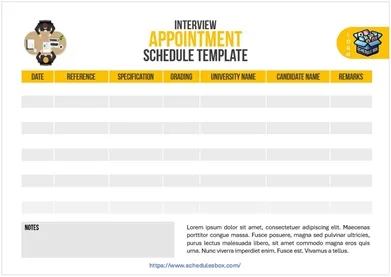
Interview Appointment Schedule Template

Interview Appointment Schedule Template


File Type: MS Word (ZIP File)
File Size: 234 KB

Download Now

Interview Agenda Schedule Template

Interview Agenda Schedule Template


File Type: MS Word (ZIP File)
File Size: 93 KB

Download Now

Interview Schedule Templates Components

Interview schedule templates contain all the essential ingredients that are necessary to organize the interview session with success:

Candidate Details

One of the imperative components of using an interview schedule template is that it provides detailed information about the candidates. Moreover, it will enable you to list down the applicant’s name in a sequence along with the position they applied for. In addition, you will also get information about their contact details. So, in case of any change in the schedule or sharing any other information, you can easily convey the message to the candidates.

Interview Information

Another significant component of this recruiting scheduling tool is information about the interview. This section contains details about the interview, like when the interview is going to be conducted and at what time and place. Furthermore, this section will also showcase information on whether the interview is going to be conducted online via video link or physically. In this manner, all the information can be shared with the recruiting team and applicants, so they can prepare themselves beforehand.

Interviewer Details

This well-organized layout also includes segments to incorporate information about the interviewers. You can write their names, designations, and contact details. They are the ones who ask questions during interviews and prepare the whole session. With the assistance of an interview schedule template, the manager can keep track of those who are going to conduct an interview and how efficiently they organize the whole session without any delay or hitches.

Time Allocation and Agenda

Setting an agenda before the interview makes things convenient. These templates allow the user to create a pre-made session and detailed question segments. You can add a list of questions for different job roles to keep the conversation going. With that, you can improve your productivity and efficiency, as you don’t need to think about random questions at all. By having all the information in hand, you will be able to host the session in a short time instead of dragging the interview for longer hours. Moreover, this section will also let you plan the start and end times of interviews with closing remarks.

Important Questions

This part of the template is designed to list key questions relevant to candidates’ skills and experience. The advantage of having this section is that it won’t take long for an interviewer to overview each candidate’s credentials and make assessments based on their previous experience and skills to determine whether he or she best suits the role or not.

Note Section

Like other crucial components, this interview planning tool also has a note section. It has a great deal of importance, as sometimes recruiters get confused as to who answered the question and who did not. So here the note section comes into play. The interviewer can jot down his observations and take notes while interviewing the candidate on the template, keeping everything organized. So that’s how every applicant gets an equal chance to be fairly evaluated for the job role.

Therefore, the interview schedule template is an ideal pick for the recruitment process and to keep things organized. It keeps the whole process simple and stress-free by eliminating the workload in the recruiting department. Thus, start using interview schedule templates now and conduct stress-free interview sessions.

Leave a Reply

Your email address will not be published. Required fields are marked *